If you’ve ever stepped on the scale and felt like it determined your worth, you’re not alone. For years, we’ve been taught that weight is the ultimate indicator of health.

But here’s the truth: your health is about so much more than a number. In fact, focusing too much on weight can derail your well-being and even increase the risk of disordered eating. So, let’s reframe how you think about health.
This guide offers five powerful ways to measure your health without relying on a scale. They’re rooted in real, sustainable wellness, not perfection or obsession. Whether you’re starting a new routine or trying to let go of diet culture, these indicators will help you track meaningful progress and feel better in your body.
1. Measure Your Health by Your Energy Levels and Sleep Quality
One of the first signs that your health is improving (or declining) is how you feel day to day. Do you wake up energized or already drained? Do you crash at 3 p.m. or power through the day with focus?
Start tracking:
- How rested you feel upon waking
- Your energy dips and peaks during the day
- Whether you need caffeine just to function
- The ease with which you fall and stay asleep
Sleep and energy levels can be influenced by nutrition, hydration, mental load, stress, hormones, and more. Rather than chasing a number on a scale, try aiming for consistent energy and restorative sleep as your wellness benchmarks.
Internal Link: Self-Care that Sticks: How to Build a Wellness Rhythm That Works for You
2. Measure Your Health by Looking at Blood Work and Biomarkers
If you want measurable progress, look inside, not just at your reflection. Comprehensive blood work can reveal so much about your health.
Track biomarkers like:
- Blood pressure
- Blood glucose levels
- Cholesterol (LDL, HDL)
- Triglycerides
- Thyroid function
- Iron and vitamin levels
Getting this information once or twice a year can help you fine-tune your habits, catch early warning signs, and make decisions based on real health, not your appearance.
3. Measure Your Health by Tracking Your Mental and Emotional Well-being
Let’s be honest, what good is “health” if you’re anxious, exhausted, or spiraling in self-doubt? Mental and emotional wellness are core indicators of health, even if they don’t show up on a chart or in your bloodwork.
Ask yourself:
- How often do I feel calm, grounded, and clear-headed?
- Do I feel capable of handling stress without falling apart?
- Am I obsessing over food, movement, or my body?
- Can I find joy in everyday moments?
Improving your mental health may involve boundaries, therapy, medication, or simply letting go of toxic expectations. Don’t dismiss it! It’s just as important as your physical health.
4. Measure Your Health by Monitoring Your Physical Performance and Endurance
Your body is not an ornament, it’s an instrument. And what it can do often says far more than how it looks. Whether you’re walking, dancing, lifting, or climbing stairs, movement is a valuable health metric.
Track changes in:
- Stamina and endurance
- Strength gains (heavier weights, more reps)
- Flexibility or balance
- Recovery time after activity
If you can do more today than you could last month, you’re making progress. Period.
RELATED: Results365: Your Guide to a Year of Empowering Workouts
5. Measure Your Health by Looking at Daily Habits and Self-Care Routines
Habits are often the clearest indicators of long-term health. Are you consistently nourishing your body, moving it with care, getting rest, and practicing boundaries?
Pay attention to:
- How often you prepare meals vs. skip them
- Water intake and hydration levels
- Your screen time and wind-down rituals
- Time spent on joyful or creative activities
Small, repeatable behaviors form the foundation of your wellness, not weight fluctuations.
Why Obsessing Over Weight Can Be Harmful
It’s linked to:
- Increased risk of eating disorders
- Elevated cortisol and chronic stress
- Weight cycling and metabolic damage
- Decreased self-worth and body trust
The scale doesn’t measure your values, your strength, or your resilience. It doesn’t account for your progress, joy, or healing. And it certainly doesn’t get to decide whether you’re healthy or not.
How to Embrace a Weight-Neutral Approach to Wellness
You can care about your health without making weight your main goal. A weight-neutral approach means focusing on actions and outcomes you can actually control, like how you feel and what you do, rather than numbers that fluctuate for reasons beyond your control.
Steps to try:
- Track non-scale victories (NSVs)
- Stop weighing yourself altogether
- Set process goals (e.g., 3 walks/week) not outcome goals (e.g., lose 10 lbs)
- Use health data (like blood work) to inform your habits
Remember: Body autonomy matters. You get to decide what’s right for you. But if focusing on weight is causing more harm than good, it’s worth exploring another path.
FAQs
Is it okay to want to lose weight and still focus on health?
Wanting to change your body is normal in a culture that teaches you to be dissatisfied. Body autonomy is important but so is understanding the risks and asking why you feel the need to pursue weight loss.
How often should I get blood work done?
For most healthy adults, once a year is a good baseline. However, frequency can vary based on age, medical history, symptoms, or provider recommendations. Blood work is one of the most objective ways to track internal health markers like cholesterol, glucose, thyroid function, and nutrient levels.
Can I still track progress if I’m not using a scale?
Yes and in many ways, it’s more meaningful. Progress can show up in your energy, sleep, strength, mood, digestion, and consistency with daily habits. These indicators often change before weight ever does, and they give you a more accurate picture of real health improvements.
What are the best alternatives to tracking weight?
Some of the most useful alternatives include:
- Energy levels throughout the day
- Sleep quality and consistency
- Strength, stamina, and recovery in movement
- Lab work (blood pressure, glucose, cholesterol, iron, etc.)
- Daily habits like hydration, meals, and stress management
These reflect how your body is actually functioning, not just how it looks.
How do I know if I’m actually getting healthier without weight changes?
Look for patterns over time, not day-to-day fluctuations. Signs of improving health often include:
- Fewer energy crashes
- Better sleep quality
- Improved focus and mood stability
- Increased strength or endurance
- More consistent routines with food, movement, and rest
If multiple areas are improving, your health is improving—even if your weight stays the same.
Isn’t the scale still useful for health?
It can be a data point, but it’s a limited one. Weight fluctuates daily due to hydration, hormones, digestion, stress, and more. On its own, it doesn’t tell you how healthy your body is functioning. For many people, especially those recovering from diet culture patterns, it can do more harm than good.
What are non-scale victories (NSVs)?
Non-scale victories are real signs of progress that have nothing to do with weight. Examples include:
- Sleeping through the night
- Feeling stronger during workouts
- Having more stable energy
- Reduced cravings or food anxiety
- Feeling more confident in your body’s abilities
- Being more consistent with healthy habits
They help shift focus from appearance to actual well-being.
What if focusing on non-scale metrics makes me anxious too?
That’s a valid experience. Any form of tracking can feel stressful if it becomes obsessive.
If that happens, it may help to simplify: focus on just 1–2 indicators (like sleep and energy), or shift entirely toward qualitative reflection like “How do I feel today compared to last month?”
How do I start letting go of the scale without feeling lost?
Start small. You don’t need to overhaul everything at once. Try:
- Removing the scale from daily use
- Tracking one non-scale metric for 2–3 weeks
- Writing down daily energy or mood patterns
- Focusing on habits instead of outcomes
The goal isn’t perfection, it’s rebuilding trust with your body’s signals.
Final Thoughts
You deserve to feel good in your body, and that feeling isn’t found on a scale. True health is about how you live, not what you weigh. By focusing on markers that reflect your full well-being, you create a foundation that actually supports you for the long haul.
Ready to ditch diet culture and embrace real wellness? Start with the Gentle Nutrition Toolkit and let’s redefine what health means, on your terms.
The Gentle Nutrition Toolkit
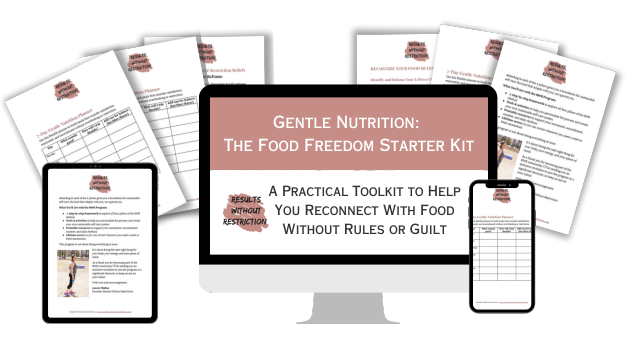
What’s inside the Gentle Nutrition Toolkit
Worksheet: Recognize Your Food RulesIdentify old or hidden food rules you’ve been following—often without realizing it. Reflect on where they came from, how they’ve shaped your relationship with food, and use guided prompts to reframe them with affirmations that center trust, flexibility, and self-compassion.
7-Day Gentle Nutrition Planner
A no-pressure, flexible weekly planner designed to help you think ahead about meals with satisfaction, nourishment, and ease in mind. Encourages structure without rigidity, no tracking, no restrictions, just space to support your needs and preferences each day.
The Hunger & Satisfaction Scale
A printable, visual tool to check in with your body before, during, and after meals. Helps you build awareness of hunger and fullness cues so you can eat in ways that feel physically and emotionally satisfying without judgment.
Mindful Eating Prompts
A set of simple, cut-apart cards to place on your table, desk, or kitchen counter. Use them before meals to pause, connect with your body, and create a more intentional, satisfying eating experience.
Identify Your Food Rules & Restriction Beliefs Cheatsheet
A checklist-style guide to help you recognize the more subtle ways diet culture might still be sneaking into your thinking. Great for building awareness and starting to shift toward more aligned, peaceful food choices.
Reflection & Next Steps Page
An invitation to notice what’s changed as you’ve worked through the toolkit how your mindset, meals, or mood may feel different—and gently name the next steps or practices you want to keep exploring as you move forward.




![10 Legit Apps That Pay You to Walk (Real Money & Rewards) [UPDATED]](https://www.resultswithoutrestriction.com/wp-content/uploads/2024/05/apps-that-pay-me-to-work-out.png)