Subscribe: Apple Podcasts | RSS
In this episode I talk to Debbie Waidl, a Migraine Specialist certified through the Institute for Integrative Nutrition and the Institute for Functional Health Coaching.
Table of Contents
Meet Debbie
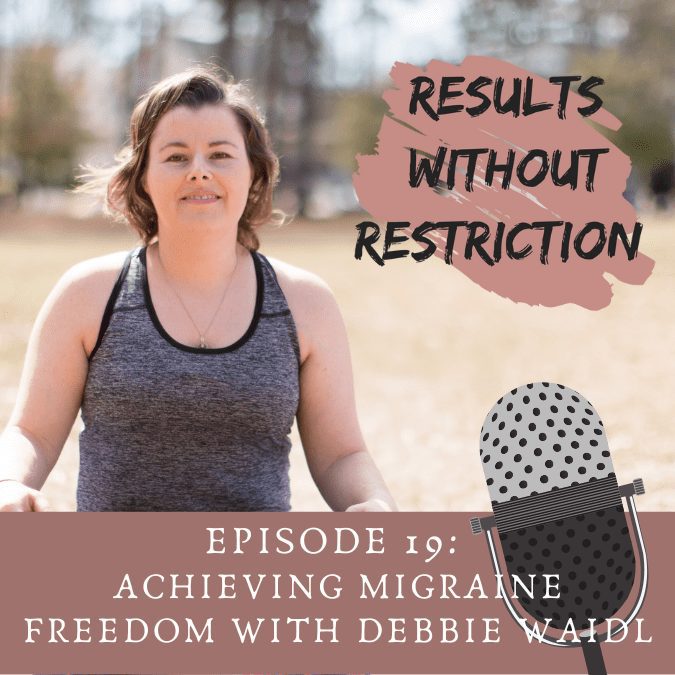
As a migraine specialist, she helps busy moms uncover what is holding them back from migraine freedom so they can live their life pain- and symptom-free, spend the time they want with family and friends, and stop missing out on the things they enjoy.
In this episode she explains her 3 Pillar approach to Migraine Freedom, and how she teaches her clients to make subtle shifts in their busy lives to improve their quality of life without relying on countless medications and following complicated migraine elimination diets.
Her passion to help moms live migraine-free stems from her own experience with daily migraines and her desire to ensure no one has to live through years of endless migraines as she did.
- Connect with Debbie on Instagram
- Visit Debbie’s website: https://debbiewaidl.com/
Episode Transcript
Welcome, everyone. Today, I am sitting down with Debbie Weidl and she is a certified health coach and a migraine specialist. She’s the founder of In the Balance Health Coaching and the Freedom from Migraines method.
And today, she’s going to talk to us about the work that she does helping busy moms who are dealing with migraines so that they can live their life pain and symptom free, spend more time with family and friends, and stop missing out on the things that they enjoy. Welcome, Debbie. Thank you.
I’m excited because migraines are one of these things that I feel like most of us have experienced or struggled with or battled with depending on the extent of your experience with migraines for a long time. And there’s so much mystery around migraines, what actually causes them. And a lot of us, if you saw a treatment for it, then we’ve gotten the runaround, take pills, do all these things, and it’s like, you know, what are our other options? And I know that a lot of people in the audience want to know, aside from just popping a pill, you know, what can we do to prevent them and treat them and get back to living our best lives migraine free? So I’m super excited to dig into this with you.
Our audience is mostly women, mid-30s and up, and as we get into kind of like, you know, perimenopause and hormonal changes and things. And a lot of us are starting, even if you didn’t have migraines before, you might start to experience them now. So I think this is a really good topic for us to dig into.
So Debbie, what I want to do first, I want to get into your backstory. I call it the origin story, right? So tell me how you got to this point where you became a health coach who focuses exclusively on helping women with, to manage their migraines. Absolutely.
So I think as the story goes for most of us, you know, this was our experience, right? It was the life that we lived. I had what I thought were headaches on and off when I was young and I had very bad cycles. I was actually, this is so sad, but I was put on birth control at the age of 12 because that was the answer back then.
That’s what doctors thought they did, you know, to try to help with someone who had painful periods and headaches around there. They weren’t horrible, you know, but as life went on in my 20s, I started noticing a few more headaches. And then after the birth of my second child, it was migraines.
And I have a family history. My mother has migraines, my sister has migraines, my grandmother has migraines. So I really thought I was destined for this life with migraines because that’s what we knew back then, right? You know, it was take the pill, try to manage it and live your life.
And as time went on and my migraines started becoming chronic, I got daily migraines for almost 10 years. I knew there had to be a better way. And I realized in my 30s, I was on seven different prescriptions, taking over-the-counter medications like it was candy, like literally could go through a bottle of Advil in a week.
I knew there had to be a better way. And that’s when I started doing research on my own and found the support of a functional health coach in my area and started really digging into the roots, why I had migraines, what that meant and what I could actually do to put myself back in control of my health and find a way to end them. And I can sit here today and say that I am over 10 years migraine-free, do not take medications for migraines, did not have to do risky surgeries and really turned my life around.
And it is my mission now to make sure that women like me do not have to go through the same thing. Well, that’s really inspiring and it gives a lot of us hope, especially those of us who are really crippled by chronic migraines. So let’s see, like before we get into the who, what, when, why, how, tell us a little bit, like define migraine for us, right? Because sometimes people are like, I don’t know if it’s, I have a headache, is it a migraine? I’m not sure.
So what does it look like? Absolutely. So you’re going to get 50 million definitions if you go on Dr. Google, so don’t. You know, it’s going to give you all of that.
It has to be on one side. It has to have to have an aura. You have to be nauseous with it.
But really, if you are feeling head pain, if you whether it’s stabbing or pulsing, if you’re feeling neck pain, those symptoms, you can pretty much put yourself in a category of having some sort of migraine. I don’t really care what they call it. You go to doctors, they have different names for different kind of migraines.
But if you have that head pain, then basically your body is trying to talk to you. We talk about migraines as being an actual symptom, not necessarily a disease that you read about online, but it’s your body’s way of actually speaking and communicating with you to tell you that there’s something wrong. Your body can’t speak English.
This is all it has. So when you feel that head pain, when you feel that nausea, when you have spots in front of your eyes, or you have gut pain, all of this is your body’s way of letting you know there’s a deeper problem. And that’s what we get into.
So even though we help women and their migraines, we are really focused on what the root cause is, and the root cause is inflammation. Once we deal and tackle with someone who has chronic inflammation, all of these symptoms are gonna start to go away. Not just the migraine, but probably a lot of the other symptoms that you’re feeling at the same time, or possibly autoimmunity, or some chronic health conditions.
Our clients come to us with migraines and other things, and they leave feeling like a totally different person because we got to the root of why they were experiencing all these symptoms to begin with. Okay, so for most of us, migraines are the thing to be treated, right? So we go to the doctor or we go to CVS or whatever, and we’re like, okay, I have a migraine, I’m gonna treat the migraine. So what you’re talking about is actually the migraine isn’t the problem, the migraine is the symptom of the underlying problem, and getting, solving the root problem can actually eliminate or minimize the impact of migraines.
Exactly, because when you go to CVS, when you go to the doctor, whatever it is, to get your meds, really what you’re doing is you’re managing pain. You’re not ending pain. You’re working on managing what you’re feeling in the moment and kind of covering it up.
It’s kind of like putting duct tape on someone’s mouth. They’re still talking. The noise is still there, and you’re just not hearing it as well.
And that’s the same thing with a medication. You know, you’re kind of dulling how you’re feeling that pain, but the issue of why you’re feeling the pain is still there. The longer this goes untreated, yeah, the longer it goes untreated, the more that you need to work on covering it up, which is why people start with one med and some of the women in my group, they’re on like 15, 20 medications before they work with me, because we just keep covering, covering, and covering up the pain instead of getting to that root cause of it.
I wanna share, like I wanna go back real quick and share my experience with migraine. No, I’m very fortunate. I think I, in my lifetime, I mean, I maybe get migraines maybe a few times a year, but my first migraine, I’d always heard of migraines.
I had a good friend growing up. Her mother had like debilitating migraines like lock herself in, throwing up, locking herself in a dark room for a weekend. To me, that was a migraine, like your life shuts down.
So I was probably in my early 20s and I was at work and I started to see spots, like the little fireworks, right? Anybody who’s had an aura knows what I’m talking about. It’s like the little, it almost looks like, I call it like psychedelic Easter egg is kind of what it looks like to me, right? And it started, and I was like, well, that’s kind of weird. Like I can’t see in this little spot.
This is so weird. And then it started to get bigger. And then it started to get bigger.
And I was like, oh my God, am I having a stroke? I’m 20, I don’t know, 21, 22. Like what is, that was terrifying. I had no idea.
Nothing hurt. It just, I couldn’t see. And so this, and it gets bigger and it gets bigger.
And I was like, I, like my whole field of vision, like I can’t even see, I can’t drive, I can’t do anything right now. And then it went away and I was like, oh, well, that’s great. I don’t know what just happened, but it’s gone.
But guess what happens after that? The pain, the pain, the pain. And I had no idea it was coming. And for three days, that was me.
I didn’t throw up, but I did was, you know, nausea, queasy stomach, couldn’t eat, couldn’t look at anything, everything hurt. And I was like, oh, I think I know what’s happening. The light kind of went on.
I was like, oh, I think I know what’s happening here. So I consider myself fortunate that, you know, if I, I found that if I, if I take some Excedrin or I take something real quick, when I had the aura, I can minimize the impact. So that was, I consider myself, and if I do take it, I still kind of feel gross for a few days, but it’s manageable and functional.
It’s, you know, it’s not knocking me out for three days, but, and I do find that- Yeah, we call that the migraine hangover. That’s our migraine hangover. That’s exactly what it feels like.
I want to go out and get like a greasy Big Mac. I don’t eat meat or dairy, but I’m like, I could go for some like hangover food right now, because that’s like, that’s all, that’s a good, you know what, that’s a great descriptor, cause that’s exactly what it feels like. But, and for me, I found like change of seasons, stress, those were really like what I observed to be triggers for me, or what I assume are triggers.
I don’t, I don’t, for me, they’re not, they’re not serious enough that I spend a lot of time trying to figure it out. I just manage it as I go along, but I would love, I’m really looking forward to finding out from you what I can do to prevent them in the future. So this is great.
Okay, so when you work with clients, and you said, you know, they come to you, they’re on, they’re managing pain, they’re taking multiple medications, what does it look like when they get it under, when they follow your protocol or your program, what does it look like for them to go from point A to point B where they’ve kind of identified that route and addressed it, what does it look like? Yeah, so every single person that comes to us is different. And this is why finding migraine freedom is so difficult because women spend, women that have migraines are probably the best researchers on the face of the earth. They spend literally hours a day trying to find how to end their pain.
But the problem is Dr. Google is out there giving information that’s general. And that is not how you get to the bottom of your root cause because there are six key areas of inflammation that we look at, but we have to remember that with every single person being different, they can have a different version of those six key areas. So we help them depending on who the person is, what their health history, if we are able to help them, we bring them in and then we work them through a process of determining where the inflammation is coming from them, what they need to do to reduce that in a way that they can actually sustain for the rest of their life so that this isn’t, hey, you work with me for a few months, you go away and your migraines come back, right? We need to look at their lifestyle, who they’re living with, the age of their children, if they’re working, not working and come up with a plan that’s actually gonna work for them to reduce that inflammatory load while at the same time, allow them to live the life that they wanna be able to live in a way that they can sustain that forever.
That makes a lot of sense, right? Because you’re talking about managing inflammation and if your lifestyle is such that you’re constantly encountering inflammatory foods, environments and things like that, like you need to be aware of what you can do to mitigate or manage those influences, right? For your particular situation, you mentioned working, having kids, dietary restrictions or just either by choice or allergies or things like that, so you need to take all of that into consideration in order to create a sustainable and I think that’s key, right? Because if it works for 12 weeks and they go three months with no migraine and they’re like, yay, this is great but if it’s not something they can keep up, like that’s pretty useless. So being able to manage this long-term is the key here for success with your program and I love that. So you mentioned going to Google and finding that the research and the solutions that the internet provides are general, right? And I’m gonna go out on a limb here and say a lot of this research is done on men.
It is because there is not a lot of research that’s allowed to be done on women in their reproductive years. Yeah. So guess what? How does that help? How does that help us? It doesn’t, it doesn’t.
And I specifically work with the majority that I work with are women because there is a different way to be able to help both, you know? So the group that I have, the Women’s Migraine and Freedom Group, it is a group of 3,000 women and if I work with men, it’s just a couple on the side. You know, migraines are still migraines but you do kind of come at it a little bit differently. Plus let’s face it, men and women typically have different ways they want to approach things and it’s all about that sustainability, right? Absolutely.
So let me ask you this. When people come to you, so somebody says, oh, I’ve been struggling with migraines. I don’t wanna call them mistakes but what in your observations or you know, in your experience, when people come to you, what have they been doing that may have been exacerbating their condition or making it worse and not helping? Like they’re trying to help, they’re actually making it worse.
What are some of those things that we can be aware of? And this is an easy question to answer cause I did them all. You know, when I jump on a call with someone, I want them to know I’m like, you’re an amazing person but you’re no different than anybody else. You know, we’ve all done this.
We’ve all gone through it. So you can’t feel bad. But you know, when you get a migraine, the only thing you can think about is being out of pain.
So you are literally willing to try anything. I mean, right now, if you said to me, I was able to end my migraines and never get them back again by eating rosemary on a Tuesday, upside down, drinking a glass of water, guess what? Almost everybody’s going to do it, right? They’re going to try it because they’ve been in pain and they don’t know what else to do. So I did all the diets.
You know, your neurologist says to you, don’t eat chocolate. Don’t drink red wine. You know, make sure you don’t do MSG.
You know, so you’re like strict to no end on that. And then you start getting rid of everything. No gluten, no dairy, no soy, no sugar, no wine, no alcohol.
Yeah, I mean, by the time you’re done, you’re eating cardboard, right? But the problem is, you’re eating rocks and sticks in the woods and you have no friends and no social life. Exactly. And everything I just listed can be inflammatory without a doubt.
You know, all the foods I just listed. But the thing is, what level do you need to go to? Like me, maybe I just needed to get rid of gluten and sugar and I’d be fine. Maybe somebody else needs to get rid of gluten, dairy and sugar just for four months, get the inflammatory load down, then go back to maybe eating some of those foods, right? So everyone is different.
So I did the diets. You know, I did the no exercise because I thought that when I exercised, I got a migraine, which was kind of true, but let’s face it, I got a migraine every day. So it didn’t matter if I exercised or not, I was still getting migraine.
I did the medications. You know, I was told to take a medication instantly the minute I felt pain to take that medication right away instead of trying to see why I was getting that migraine and trying to end it, I took those meds right away. So those are like the key three things that I think hurt most people is they don’t exercise the way that they should in the way that’s right for their body at the moment.
They trust that medication is the only way to end. And I would just like to stay here before anybody goes nuts. I am not anti-med.
I am anti-med for life on most things. So in my ideal world, a client would go to their doctor, say they have migraines, the doctor would give them a medication to help them manage their pain in the moment. Then they would go work with someone like me to get to the root cause so that when they go back for a follow-up with their doctor, they don’t need to get that medication again.
That’s an ideal world, but that’s not what it says. That’s the perfect scenario right there, right? We solve the problem, we solve the immediate problem and then we look for a long-term solution. Exactly, but it’s not what happens.
You go back to the doctor, they give you another pill. They go back, they give you another pill. Certain people, yes, have to be on medication for life.
You have a transplant, you need to be an anti-rejection meds. You’re type one diabetic, you need to be on insulin. Those kinds of things make sense, but no one has a Sumitript indeficiency.
You don’t need to be there for life, right? We don’t, so. Exactly, exactly, I love this. So Debbie, let’s talk about working with you in the program that you have created to help people with their migraine situation.
Let’s dig in. Absolutely, so the majority of the way that I work with women is through the Freedom for Migraine method. It is a four-month program where we literally take you step-by-step through what is causing your inflammation.
We have a foundational approach in the program, but the reason it’s successful is because we take that foundational approach and with you help you actually tailor it to fit your lifestyle. So at the end of the day, you are the one in control, not your migraines, not me. I’m there to guide you.
I’m there to give you the research and my expertise of working with thousands of women, helping them find reducing the severity, duration, and frequency of their migraines. But you tailor that program to make sure that it’s something that you can live with for life and sustain. So that’s our signature way.
We do jump on a call with every single person before we work for them. You cannot sign up for my program without filling out an application and talking to us because we wanna make sure that we can actually help you. If we cannot, we’re gonna put you in contact with someone that can because there are cases that are way too severe for me, you know, that have way too many health restrictions that we need to make sure that we get you to a professional, but then there are also people that aren’t ready.
And if you’re not ready, I am not going to put you through a program and have you spend money on something that is just gonna be one more thing that doesn’t work for you. So we have a very strict process of making sure that women are at the point where they are health wise and emotionally wise ready to do that. But then also we do have some one-on-one coaching needed it.
We have another program called Destination Zero for those that are a little bit more complex, you know, in a few other ways, depending on where you’re at. So we put a lot of thought process into where you’re gonna fit and what’s gonna be the best avenue for you to get the results that you’re looking for. I love this Debbie because what I like about this is it’s a client led approach, right? The client is 100% in control the entire time.
This isn’t like a cookie cutter you show up, you’re gonna cut out this list of foods, you’re gonna do, you know, these exercises you’re gonna do, you have to do these XYZ. You’re working one-on-one with people to find the solution that is gonna work for them. And I also love that you’re not, you’re not just taking anybody, right? You wanna make sure that the people who are coming in to work with you are ready and they’re gonna be able to benefit from the work that you’re gonna do with them.
Exactly, and if someone’s not ready, we help them get ready. We don’t just say, bye-bye. Right, you don’t just kick them out and go, good luck.
Exactly. Check back when you’re in worse pain, we’re not, you know, we can’t help you right now. Right, I love that.
So there’s an approach for, okay, you’re not ready right now, here’s what you can do to kind of get to that point and then we can work together. That’s fantastic. 100%, we give them resources and follow through and make sure we’re constantly checking up on them because that’s, at the end of the day, one in four women right now are suffering with migraines and it’s our company’s mission to take that number to destination zero.
And we will do it one woman at a time, whether that’s through us, through a referral, or through giving them the resources that they need to get ready to go to the next step. However we need to do that, that is our job and our mission to make sure that people don’t have to deal with what we deal with. And my team and myself, we’ve all had migraines.
We’ve all gone through the program so they know exactly how each woman is feeling when they come in to the program and when they’re working with them. And I think that as women, we’ve probably all had the experience of working with a medical provider who was less than sympathetic to what we were going through. So I think that right there is really helpful to know that who you’re working with in your program, you, your team, they’ve been there.
They know exactly what it’s like to be laid out for a weekend or not being able to spend time with your family or your friends or go on vacations or do things because these migraines are just debilitating. Now I have a friend who is struggling with migraines right now. She has tried all the things.
And I think she’s gonna be very interested in this particular episode. So I’m really excited because I mean, this isn’t my issue, but I know so many people who this touches personally. So I’m really glad that we connected and we can share this information.
We can get this out to the audience. So one of the things, I don’t know if we covered this already, but I just wanna dig, I just wanna go over it a little bit. You mentioned that your program is a three pillar approach.
What are the three pillars? Absolutely. So we look at building the migraine buffer and this is gonna be where we dive deep into your nutrition and your electrolyte symmetry to make sure that the foods that you’re eating are right for you. Not right for everyone else out in Google land, but right for you.
And that based on the food that you’re eating, that your electrolytes are actually being balanced. We talk a lot about drinking water, dehydration, all that kind of thing. But the two have to go together.
They don’t work in isolation. So we do building the buffer first. And this is gonna start giving women a little bit more of a gap between their migraine free days and their migraine days so that they actually have the energy to be able to work on the rest of the program.
Because this is not like, and I love weight loss programs, so don’t take this as an offense, but it’s not like a weight loss program where you feel okay every day to work on it. These women half of the time feel horrible. So they have to find a way to work through a program while they’re in pain.
So the first thing we need to do is give them more pain free days so that they can actually start focusing on making changes. So we do building the buffer, then we move into what we call living under the migraine threshold. And this is where we’re gonna start making little subtle shifts to their lifestyle, the environment that they’re in, the double checking also, again, the foods that they’re eating so that we can actually start raising their ability to be able to handle a trigger without it causing pain.
So most people that have migraines, they have a threshold, and I know this might be on audio, but they have a threshold, if you can see my hands, it’s really tiny, right? And by doing things in the program, we wanna actually raise it higher and higher and higher so that every little trigger they come into contact with, as long as it’s below that threshold line, they’re not gonna get a migraine. But the women that come to me, their threshold is so tiny, one little thing happens, they get a migraine. The weather changes, they get a migraine.
They drink wine, they get a migraine. They get in a fight with their husband, they get a migraine. So for you, when you experience those few migraines here or there, it probably was due to the fact that you came into contact with too many triggers that pushed you over the threshold.
Your threshold is probably very high, which is why you still don’t get them, but something triggered that. So we work on all those areas and then we move on to the third pillar for those that still need support. This is called detoxing from the past.
This is gonna be where we actually take a look at the toxic load that you come into contact with daily and really dive through and do some toxicity mitigation. So for example, are you taking a ton of medications? Because guess what? Every medication has a side effect. Every medication leaves toxins in your body.
Are you eating foods that are organic? And I’m not saying you have to change everything to organic, but the more you eat that’s not organic, the more toxins you’re putting in the body, the more we have to eliminate. So on and so forth. Perfumes, air quality, all those kinds of things.
We actually had someone who came into the program, she was a physical therapist. She spent her day in a pool. So guess what? She’s soaking in chlorine all day.
It’s a toxin. So we have to look at your level, figure out how we can lower it to the point that your liver can handle. Because it’s your liver’s job on a daily basis to clean all that out, but your liver can only do so much in a day.
So we like, we talk about it in like cups. So think about a coffee cup. If your body can handle a coffee cup’s worth of toxins in a day and clear that out.
But if you give it three, all of those other toxins stay floating around in your body. And one key toxin that I want to mention, because this is huge for my audience. If you are someone, and hopefully you don’t mind poop talk on your show, but if you are someone that does not eliminate on a daily basis, fully, like go to the bathroom and you feel like you’re cleaned out and you’re a happy person.
If you do not do that on a daily basis, guess what happens, ladies? That stool will get reabsorbed into your bloodstream and cause toxins. Well, that’s gross, all right. Is it? But it’s super important to know because you go to the doctor and the doctor’s like, oh, you’re going to the bathroom a couple of times a week.
That’s okay. No, it’s not. If you are not eliminating on a daily basis, I don’t care if it’s eliminating once or three times.
It doesn’t matter. You know, I typically go to the bathroom twice a day, you know, and I feel empty both times and I feel good. But if you’re not doing that, you’re filling your body with toxins.
So within these three pillars, these are all the six, there’s like two or three key areas in each one. That’s all six key areas that we need to work on to reduce that inflammatory load to get you to where you need to be for your migraine freedom. That sounds, I mean, that sounds comprehensive.
Like, so you’re starting with kind of making sure that they actually have the bandwidth emotionally, physically, whatever, to actually implement the program. And then it sounds like the second part almost sounds like an adaptogen style approach where you’re kind of increasing their exposure to certain triggers so that it won’t, you know, gradually increasing that exposure to the trigger so that, you know, you can figure out what’s, you know, gradually raise it. And then making sure that the calls aren’t coming from inside the house, right? So it’s like, what’s happening inside that might be, and reducing exposure to those kinds of internal, you know, like an internal trigger, but it’s like, you know, cause for a lot of migraine things we’re looking at outside, right? Like weather, light, air pressure, you know, stress, things like that.
But sometimes it’s what’s happening inside that we need to take a closer look at. So that’s really key. Absolutely.
And then since you mentioned inside, most people think that their migraines are caused by hormones. That is a huge one. And while they may be correct, we need to remember that we have over 50 hormones and it’s not just the sex hormones that are causing an issue.
So for those of you who want to go on HRT, want to go on the pill, want to get on these creams, guess what? That is just another band-aid like medication. And using the six key areas so we can actually help you get your body back to balancing your own hormones, whether you’re impairing menopause or not. Good to know.
I always assumed it’s, you know, it’s cycle related those hormones, but you’re right. There are other like cortisol, leptin, ghrelin, like all these other hormones that could be pushing the buttons from the inside. So that’s really great.
So Debbie, you have a review for the audience that I’m going to be putting this in the show notes and linking so everybody can grab this. It’s called the five ways to flush out migraine causing toxins, which is what you just talked about, the calls that are coming from inside the house. And so that might be a good way to kind of start identifying, you know, maybe, or getting to the point where you have the buffer, where you have, you know, give yourself that time space where you can, and the energy to start, you know, investigating how you can work on implementing some of these changes to mitigate migraines and eliminate them.
View All Episodes of the Results With Restriction Podcast
Subscribe: Apple Podcasts | RSS